he ball sits 25 yards out, deflated of air but heavy with expectation. David Beckham steps back。shoulders squared, eyes locked on a spot only he can see. What follows is not just a free kick but a signature—a curling, dipping trajectory that has defined an era. His free kick highlights are not merely goals;
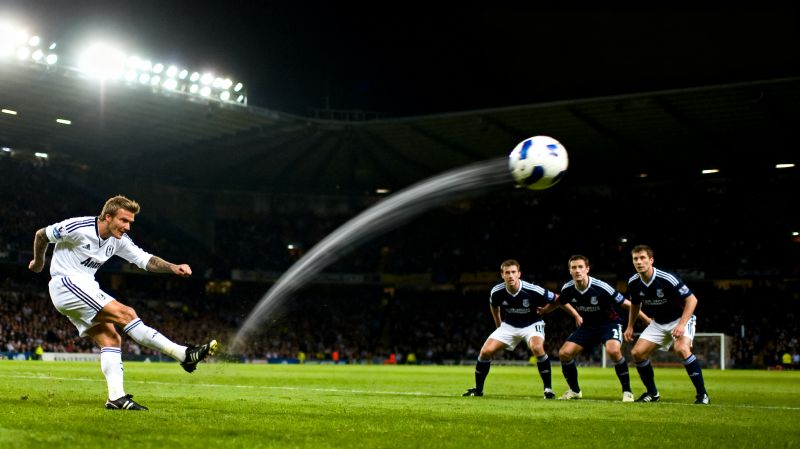
they are moments of geometric rebellion, where physics bends to will. I remember watching the 2001 England vs Greece match, the last-minute equalizer that felt like destiny scripted in slow motion. That strike wasn't luck;it was the product of thousands of hours of solitary practice, a ritual of repetition that turned a dead ball into a living threat.Beckham's technique is deceptively simple: inside of the foot, locked ankle, follow-through that points to the target. Yet the variation he achieves is staggering. Some free kicks whip over the wall and dip violently;others curl around it with late swerve. Against Real Madrid in 2003, he bent a shot from the left channel that seemed to change direction twice—a highlight that still puzzles goalkeepers. The secret lies in the contact point and the speed of the leg swing. Beckham strikes the ball with a mixture of power and finesse。imparting spin that makes the ball behave like a remote-controlled object. I've often thought that his free kicks are less about power and more about deception;the goalkeeper's brain is tricked before the body can react.What separates Beckham's free kick highlights from those of other specialists is consistency under pressure. Roberto Carlos had brute force;Juninho Pernambucano had knuckleball unpredictability. Beckham had repeatability. In the 2002 World Cup qualifier against Greece, he took seven free kicks before the final one went in. That persistence is a highlight in itself—a narrative of trial and error that culminated in redemption. His delivery from dead balls also translated to assists。
like the curling cross for Ronaldo against Real Madrid in 2003. The highlight reels often focus on goals, but his free kick assists are equally instructive: the same bend, the same dip, just met by a forehead instead of the net.There's a physical toll to this craft. Beckham's right foot took a beating—stress fractures, blisters。
and a persistent ache that he masked with tape and determination. I recall a documentary clip where he described practicing free kicks until his foot bled, then wrapping it and continuing. That obsession is the invisible backbone of every highlight. The ball he used in the 2001 Greece match was later auctioned;the scuff marks on the leather told a story of contact points refined over years. His free kicks weren't just athletic feats;they were acts of authorship, each one a small essay in control.Modern analytics have dissected Beckham's free kicks—spin rates, launch angles, wall distances—but numbers miss the drama. The gasp of the crowd as the ball rises, the silence as it dips, the explosion as it hits the net. Those are the highlights that linger. Beckham retired, yet his free kicks remain a benchmark. When a young player curls one in today。the comparison is inevitable: 'Beckham-esque.' That's the legacy—not just goals, but a standard of beauty and precision that turned a set piece into a spectacle. The ball may be dead, but the memory of its flight is alive.